How Can a Homeowner Know When It’s Time to Replace the Plumbing?
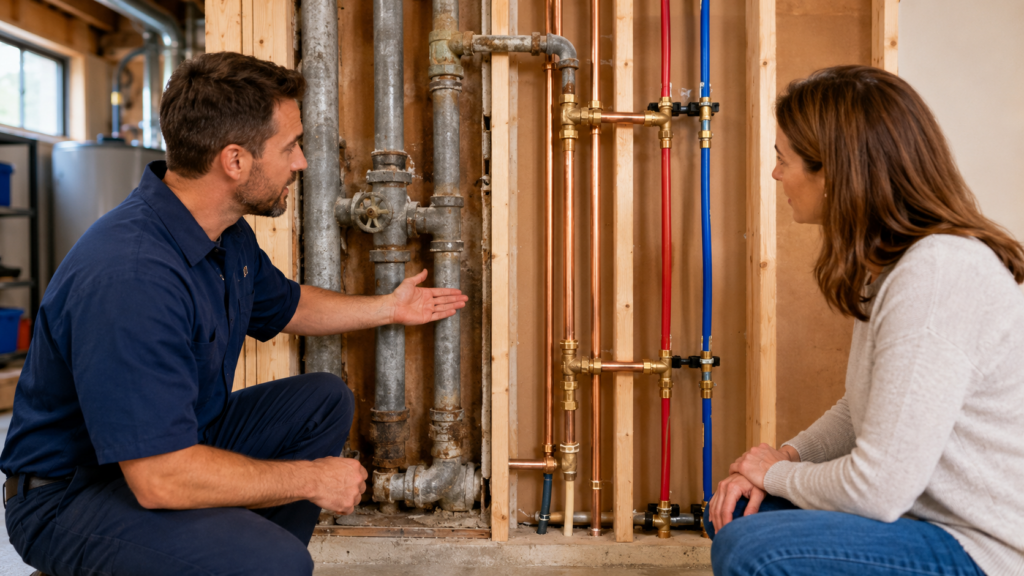
Most plumbing does not need to be replaced simply because a home is old. The decision should be based on the pipe material, its condition, water quality, and evidence of recurring problems.
Warning signs that plumbing may need replacement
Watch for:
- Repeated leaks in different locations
- Rust-colored, yellow, or cloudy water
- Low or inconsistent water pressure
- Flaking, corrosion, stains, or mineral buildup on exposed pipes
- Water that has an unusual metallic taste or odor
- Frequent drain backups or slow drains
- Damp walls, ceilings, floors, or unexplained mold
- A sudden increase in the water bill
- Galvanized steel, lead, or deteriorated polybutylene piping
- Repairs becoming frequent enough that replacement may be more economical
One isolated leak usually does not mean the entire house needs repiping. Several leaks or problems appearing in different areas can indicate that the plumbing system is reaching the end of its dependable life.
Know which pipes are in the home
Different parts of the plumbing system may require different solutions:
Water-supply lines bring pressurized water into fixtures. Older homes may have galvanized steel, copper, lead, polybutylene, CPVC, or a combination of materials.
Drain and waste lines carry wastewater away. These may be cast iron, galvanized steel, clay, PVC, or ABS.
The main service line connects the public water supply or well to the home. Its condition may differ from the plumbing inside the house.
Replacing one part does not necessarily mean every pipe must be replaced.
What are the replacement options?
PEX
PEX is flexible plastic supply piping commonly used for whole-house repiping. It can often be installed with fewer wall openings than rigid pipe. It resists corrosion and is generally less expensive to install than copper.
Copper
Copper is durable, familiar to plumbers, and resistant to heat. However, it usually costs more and can be affected by certain water conditions.
CPVC
CPVC is a rigid plastic pipe used for hot- and cold-water supply lines. It can be economical, although older installations may become brittle and should be inspected carefully.
PVC or ABS
These materials are commonly used for drain, waste, and vent lines—not usually for indoor pressurized hot-water distribution. Local codes determine where each material may be installed.
Lining or trenchless replacement
Some underground sewer and water lines can be rehabilitated or replaced without excavating the entire yard. Options may include pipe lining, pipe bursting, or directional boring. Suitability depends on the pipe’s condition, layout, and local requirements.
Partial replacement or whole-house repiping?
A partial repair may make sense when a problem is confined to one accessible location and the remaining plumbing is in good condition.
Whole-house repiping may be more practical when:
- Leaks are occurring throughout the house
- Most of the supply pipes are badly corroded
- Water pressure is poor because of internal pipe buildup
- Problematic pipe material is present throughout the home
- Major remodeling already provides access to walls and ceilings
Before deciding, obtain a plumbing inspection and at least two written estimates. Ask each contractor to identify the pipe materials, document the areas of concern, explain whether replacement is partial or complete, and state who will repair opened walls and ceilings.
Plan before an emergency occurs
A plumbing failure can cause far more damage than the cost of the failed pipe itself. Homeowners with aging or questionable plumbing should consider an inspection before remodeling, finishing a basement, purchasing new flooring, or putting the home on the market.
Home age provides a useful starting point, but visible condition and professional evaluation should determine whether repair or replacement is appropriate.
Check the likely replacement status of major home components at HomeUpdateOptimizer.com.
For additional home-value insight, visit HomeValueOptimizer.com and AVMOptimizer.com.